Best HVAC Thermometers
Reader-supported: we may earn a commission if you buy through our links, at no extra cost to you. As an Amazon Associate we earn from qualifying purchases.
Top pickFieldpiece ST4Check price
Superheat and subcooling are only as good as the temperatures you feed into them. The wrong thermometer, or the right one used badly, can put you a few degrees off in a calculation where the target window is only a few degrees wide.
Quick answer: our top picks
- Best for delta-T and line temperaturesMid-rangeFieldpiece ST4 Dual Temperature Meter (Type K)Two Type K inputs with a T1-T2 readout, field calibratable
- Best pocket thermometerBudgetUEi PDT650 Folding Digital Pocket ThermometerFolding probe, magnet and a 3-year warranty
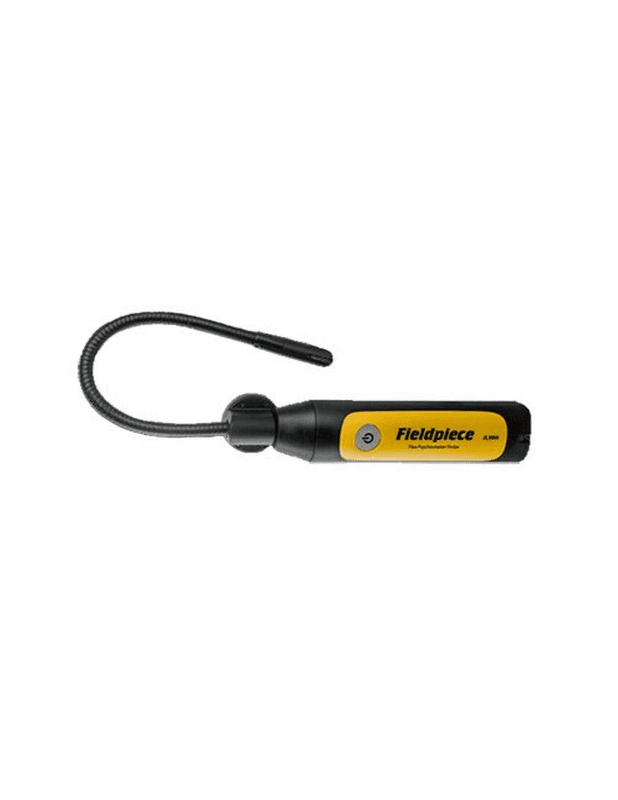
- Best in-duct air thermometerBudgetFieldpiece SPK2 Folding Pocket In-Duct ThermometerFolding rod with a hook, one AA lasts about 8,000 hours
- Best infrared thermometerProFluke 62 Max Infrared ThermometerAdjustable emissivity, IP54 and a 3 m drop rating
- Best wireless psychrometer probeMid-rangeFieldpiece JL3RH Job Link Flex Psychrometer ProbeWet bulb and dew point to your phone, up to 1,000 ft line of sight
Comparison at a glance
| Product | Best for | Type | Range | Price tier | |
|---|---|---|---|---|---|
| Top pickFieldpiece ST4 | Delta-T, superheat, subcool | Dual Type K meter | -58 to 2000 F | Mid-range | Check price |
| UEi PDT650 Folding Digital | Quick air checks | Pocket, fixed probe | -58 to 572 F | Budget | Check price |
| Fieldpiece SPK2 | Supply and return air in a duct | Folding rod, in-duct | – | Budget | Check price |
| Fluke 62 Max Infrared Thermometer | Non-contact surface checks | Infrared, 10:1 | -22 to 932 F | Pro | Check price |
| Fieldpiece JL3RH | Wireless air, wet bulb and dew point | Wireless psychrometer | -40 to 250 F, 0 to 100% RH | Mid-range | Check price |
This guide covers four jobs and the thermometer for each: a dual Type K meter for line temperatures and delta-T, a pocket thermometer for supply and return air, an infrared thermometer for quick surface scans, and wireless probes if you pair readings with a digital manifold. Infrared is not a substitute for a contact probe on copper lines.
How to choose an HVAC thermometer
- Two inputs (or two probes) for delta-T across a coil, plus a T1-T2 readout
- Probe type matched to the job: pipe clamp for superheat/subcool, bead or rod for air, IR only for quick surface scans
- Accuracy in the 30 to 120 F range where most HVAC readings fall, and whether it can be field calibrated
- Accepts standard Type K thermocouples so you can swap probes
- Wireless/app support if you pair it with a digital manifold for superheat and subcool
- Battery life and durability (boot, magnet, hook)
Match the thermometer to the reading
Line temperatures for superheat and subcool. Use a contact probe. A Type K meter such as the Fieldpiece ST4 takes interchangeable thermocouples, so you can use a pipe clamp for line temperature and a bead or wet bulb probe for air. Fieldpiece lists the ST4 as field calibratable to plus or minus 1 F from 30 to 120 F.
Supply and return air. A pocket thermometer is fast. The UEi PDT650 and the Fieldpiece SPK2 both fold their probes. The SPK2 is an in-duct air thermometer with a hook. It is not a pipe clamp, even though an older version of this site labeled it that way.
Quick scans of registers, motors and breakers. An infrared thermometer is the right tool. Do not use it for line temperature, because bare copper reflects infrared and reads low.
Wireless. Fieldpiece Job Link probes advertise a 1,000 ft line-of-sight range and pair with the Job Link app and Fieldpiece SM-series manifolds.
The thermometers in detail
Fieldpiece ST4 Dual Temperature Meter (Type K)
Best for: Techs who want one meter for delta-T, superheat and subcool with swappable Type K probes.
- Two Type K inputs; reads T1, T2 and T1-T2 at the same time
- Range -58 to 2000 F; 0.1 degree resolution
- Accuracy +/-(0.3% + 2 F) from 32 to 1100 F; field calibrated +/-1 F from 30 to 120 F
- Two front-face calibration pots
- Two ATB1 wrap-tab bead thermocouples included
Why it stands out
- True dual input with differential readout
- Field calibratable
- Accepts any Type K probe, including wet bulb and pipe clamps
Keep in mind
- Pipe clamp probes sold separately
- No wireless or app
- 2000-count 3.5-digit display
Best for: A cheap pocket thermometer for supply/return air and quick checks.
- Range -58 to 572 F (-50 to 300 C)
- 3.5 in folding probe
- Min/Max; F/C selectable; auto power off
- Magnetic mount and pocket clip
- LR44 battery
Why it stands out
- Folding probe protects the tip in a pocket
- Magnet for hands-free use
- 3-year warranty
Keep in mind
- Single fixed probe; no delta-T (PDT655 adds it)
Best for: Air temperature checks in ducts and at registers.
- Folding rod probe with hanging hook for ducts and grilles
- Min/Max/Hold; F and C
- T1-T2 difference calculation
- 1 AA battery, rated about 8000 h; auto power off
Why it stands out
- Very long battery life on one AA
- Hook lets it hang in a duct hands-free
- Pocket size
Keep in mind
- An air and in-duct thermometer, not a pipe clamp
- Fieldpiece page lists no range or accuracy
Fieldpiece lists no range or accuracy on the SPK2 product page, so treat it as a convenient air check, not a calibration-grade instrument.
Best for: Quick non-contact checks of registers, motors, breakers and connections.
- -22 to 932 F (-30 to 500 C)
- Accuracy +/-1.5 C or 1.5% of reading, whichever is greater (reduced below 0 C)
- 10:1 distance-to-spot
- Adjustable emissivity 0.10 to 1.00
- IP54; 3 m drop tested
Why it stands out
- Adjustable emissivity
- IP54 and 3 m drop rating
- Runs on a single AA
Keep in mind
- Not a substitute for a pipe clamp on superheat/subcool
- 10:1 spot ratio means you need to be close on small targets
- About 10 h battery life with laser and backlight on
Fieldpiece JL3RH Job Link Flex Psychrometer Probe
Best for: Techs using Fieldpiece Job Link or SM-series manifolds who want wireless supply and return air, wet bulb and dew point.
- RH 0 to 100%; +/-2.5% RH from 10 to 90%, +/-5% outside that
- Temperature -40 to 250 F; +/-1 F from 32 to 113 F
- Reads wet bulb and dew point
- Wireless 2.4 GHz, 1000 ft line of sight; Job Link app and SM380V/SM480V manifolds
- 2 x AAA, about 150 h; auto off 2 h (can disable)
Why it stands out
- Flexible probe with sliding magnet for placing in ducts
- Feeds superheat target and airflow calcs in the app
- Long wireless range
Keep in mind
- Sold one at a time; you need two for supply and return
- 60 s typical RH response time
- Only a 1-year warranty
Sold one at a time, so buy two for supply and return. See the JL3RH review.
Thermometers to skip or consider
The Cooper-Atkins DFP450W is a food-service thermometer, not an HVAC instrument, so skip it. The Testo 115i and the Testo Smart Probes kit are also worth a look. Testo’s 557s manifold kit is covered in our digital manifold guide.
Still deciding?
Best for delta-T and line temperatures: Fieldpiece ST4 Dual Temperature Meter (Type K). Two Type K inputs with a T1-T2 readout, field calibratable.
Check price on Amazon Budget pick: check price Upgrade pick: check price
Frequently asked questions
Is an infrared thermometer good enough for superheat and subcooling?
No. IR reads surface emissivity and is easily thrown off by shiny copper and insulation. Use a contact pipe clamp thermocouple for line temperatures. The Fluke 62 Max is useful for quick checks of registers, breakers and motors.
What is the difference between a Type K meter and a pocket thermometer?
A Type K meter like the Fieldpiece ST4 accepts interchangeable thermocouples (bead, pipe clamp, wet bulb) and reads two at once. A pocket thermometer like the UEi PDT650 has a fixed probe and is mainly for supply and return air or quick checks.
How accurate does an HVAC thermometer need to be?
Within about 1 to 2 F in the HVAC range is the useful target, because superheat and subcool targets are often only a few degrees wide. The Fieldpiece ST4 can be field calibrated to +/-1 F from 30 to 120 F.
Should I buy wireless probes?
They let you watch line temperatures and pressures together on your phone while you adjust charge. Fieldpiece Job Link probes advertise 1000 ft line-of-sight range. The trade-off is more batteries to manage and a phone in the loop.
Can I use the IR thermometer on reflective copper?
Not reliably. Bare copper has low emissivity, so readings run low. Adjustable emissivity (the Fluke 62 Max goes from 0.10 to 1.00) helps, but a contact probe is still the right tool.
Keep reading
Sources
Specifications and product details were checked against these sources: