Best Refrigerant Leak Detectors
Reader-supported: we may earn a commission if you buy through our links, at no extra cost to you. As an Amazon Associate we earn from qualifying purchases.
Top pickFieldpiece DR82Check price
A leak detector decides how long a callback takes. A good one finds the leak in minutes. A weak one sends you back to the truck for soap bubbles and a second trip. The real choice comes down to sensor type, sensitivity you can compare as a number, and whether the detector lists the newer A2L refrigerants such as R-32 and R-454B.
Quick answer: our top picks
- Best infrared detectorProFieldpiece DR82 Infrared Refrigerant Leak DetectorInfrared sensor rated about 10 years, 0.03 oz/yr stationary sensitivity, A2L support
- Best value infraredMid-rangeElitech ILD-200 Infrared Refrigerant Leak DetectorInfrared sensor at a lower price, with SAE and EN standards listed
- Best heated diode detectorMid-rangeINFICON TEK-Mate Refrigerant Leak DetectorSimple, D-cell powered, lists R-32 and R-1234yf, two-year replacement warranty
- Best for gas and refrigerantProBacharach Informant 2 Dual-Purpose Leak DetectorOne handheld for refrigerants and combustible gas, lists R-32, R-454B and R-290
- Best battery life and probe reachMid-rangeCPS LS790B Leak-Seeker Refrigerant Leak Detector40+ hours on four AA cells and an 18 inch flex probe
Comparison at a glance
| Product | Best for | Sensor | Stated sensitivity | Power | Price tier | |
|---|---|---|---|---|---|---|
| Top pickFieldpiece DR82 | Daily leak checking | Infrared | 0.03 oz/yr stationary, 0.1 oz/yr in motion | Rechargeable, about 10 h | Pro | Check price |
| Elitech ILD-200 | Infrared on a budget | Infrared | 4 g/yr | Rechargeable, 6 h | Mid-range | Check price |
| INFICON TEK-Mate Refrigerant | Residential service | Heated diode | 0.25 oz/yr minimum | 2 D cells | Mid-range | Check price |
| Bacharach Informant 2 | Refrigerant plus gas leaks | Interchangeable sensors | 0.5 oz/yr per SAE J1627 | 4 AA, 4 to 5 h | Pro | Check price |
| CPS Products LS790B | Long days, long reach | Ion pump | Better than 0.25 oz/yr | 4 AA, 40+ h | Mid-range | Check price |
| Aprvtio ALD-200 PRO | R-290 and mixed fleets | – | Up to 0.14 oz/yr | Rechargeable | Pro | Check price |
If you leak-check daily, buy infrared and skip the sensor replacements. If you check a few times a month, a heated diode unit costs less. If you also chase gas leaks, the Bacharach covers both. Compare sensitivity only between detectors measured to the same standard.
How to choose a refrigerant leak detector
- Sensor type. Heated diode sensors are cheap and sensitive but wear out and can false-alarm near contaminants. Infrared sensors cost more and are rated for roughly 10 years.
- Sensitivity as a number you can compare, in oz/yr or g/yr, ideally with the standard it was measured to (SAE J1627, EN 14624).
- A2L coverage. R-32, R-454B and R-1234yf systems are now common, so check that the detector lists them.
- Probe reach. A flexible probe of about 16 to 18 inches gets behind coils and into line-set chases.
- Consumables. Replacement sensors and filtered tips are an ongoing cost.
- Power. Rechargeable units are convenient, but AA or D cells are easy to swap on a roof.
Heated diode, infrared or ion pump
The sensor decides what the detector costs to own, more than what it costs to buy.
Heated diode detectors such as the INFICON TEK-Mate are inexpensive and respond to the whole halogenated family. The sensor is a wear item, and the kit ships with spare filters. Infrared detectors such as the Fieldpiece DR82 and Elitech ILD-200 list a sensor life of about ten years, which removes the replacement cycle but raises the purchase price. Ion pump detectors such as the CPS LS790B are well suited to humid conditions, but CPS states that the sensor should be replaced seasonally.
If you leak-check every day, the cost of replacement sensors adds up and infrared pays back. If you leak-check a few times a month, a heated diode unit is hard to beat on price.
What the sensitivity numbers mean
Sensitivity figures are only comparable when they use the same standard and the same test. Fieldpiece lists the DR82 at 0.03 oz/yr when held stationary and 0.1 oz/yr in motion, which is a more honest pair of numbers than a single headline figure. INFICON lists the TEK-Mate at 0.25 oz/yr minimum, and lists R-134a and R-1234yf at 2 g/a under EN 14624. Bacharach lists the Informant 2 at 0.5 oz/yr per SAE J1627, or 0.1 oz/yr when held at the leak for about five seconds. Those are three different tests, so do not rank detectors on one number alone.
The leak detectors in detail
Best for: Techs who leak-check daily and want infrared, so there is no routine sensor swap.
- Infrared sensor rated for 10 years typical life
- Sensitivity up to 0.03 oz/yr (1 g/a) stationary and 0.1 oz/yr (3 g/a) in motion; four user-selectable levels
- Detects HFCs, HCFCs, CFCs, HFOs and blends; works on A2L refrigerants
- Response under 1 second, recovery under 5 seconds (typical)
- Rechargeable 2550 mAh battery, about 10 hours typical with the backlight off, usable while charging
Why it stands out
- Infrared sensor with a stated 10 year typical life
- Sensitivity down to 0.03 oz/yr when stationary
- Fast response and recovery
- A2L refrigerants supported
Keep in mind
- The battery is non-replaceable
- Costs more than heated diode detectors
Best for: Budget-minded techs who want an infrared detector without the Fieldpiece price.
- Infrared absorption sensor, sensor life stated as 10 years
- Sensitivity as fine as 4 g/yr
- Rechargeable 3.7 V 3000 mAh lithium battery, 6 hours continuous, 4 hour charge
- TFT LCD with sound and light alarms
- 415 g (14.6 oz)
Why it stands out
- Infrared sensor at a lower price than the DR82
- Standards listed on the product page
- Rechargeable
Keep in mind
- Confirm supported refrigerants before buying
- Confirm warranty terms before buying
- Sensitivity of 4 g/yr is coarser than the Fieldpiece DR82 stationary rating
Confirm the refrigerant list and warranty on the listing before buying.
Best for: Residential techs who want a proven, simple heated diode detector with R-32 and R-1234yf coverage.
- Heated diode sensor
- Sensitivity of 0.25 oz/yr (7 g/a) minimum; INFICON lists R-134a and R-1234yf at 2 g/a (0.07 oz/yr) per EN 14624
- Detects R-22, R-134a, R-404A, R-410A, R-448A, R-507, R-32 and HFO-1234yf, plus other CFCs, HCFCs, HFCs and HFOs
- Two D-cell alkaline batteries
- Variable-intensity audible and visual alarms; automatic background compensation
Why it stands out
- Detects the common A1 and A2L refrigerants INFICON lists, including R-32 and R-1234yf
- Automatic background compensation, so there is nothing to calibrate in the field
- Runs on D cells, which are easy to find
- Two-year replacement warranty
Keep in mind
- Heated diode sensors wear with use and eventually need replacing
- INFICON does not state A2L compatibility in those words, only the refrigerants it detects
INFICON lists R-32 and R-1234yf among the refrigerants it detects. See our TEK-Mate review.
Best for: Techs who also chase gas leaks and want one handheld for refrigerant and combustible gas.
- Interchangeable refrigerant and combustible gas sensors in the probe tip
- Refrigerants: 0.5 oz/yr (14 g/yr) for R-12 and R-134a per SAE J1627, or 0.1 oz/yr (3 g/yr) held at the leak for about 5 seconds
- Lists R-22, R-134a, R-410A, R-32, R-454B, R-290, R-600a and many blends
- Combustible sensor minimum 50 ppm CH4; UL 913 Class 1, Division 1, Group D
- Four AA batteries, 4 to 5 hours typical with alkaline
Why it stands out
- Detects both refrigerants and combustible gas
- Lists R-32, R-454B and R-290
- Instant response and auto-zeroing
- Mute option and dual LED scales
Keep in mind
- Refrigerant sensor life is about a year, so budget for replacements
- Battery life is a few hours per set of AA cells
- Sensitivity figures are conditional on how long the probe is held at the leak
The refrigerant sensor lasts about a year and the combustible sensor about five, according to Bacharach. See our Informant 2 review.
CPS LS790B Leak-Seeker Refrigerant Leak Detector
Best for: Techs who want a long battery life and a long probe at a mid price.
- Ion-pump sensor with selective filter housing
- Detects leaks better than 0.25 oz (7 g) per year of HFC; 10 user-selectable sensitivity ranges
- Lists CFC, HCFC, HFC, HFO, NH3 and HC detection
- Four AA batteries, more than 40 hours continuous
- 18 inch metal flex probe; LED bar graph display; 128 tones
Why it stands out
- 40+ hours on four AA cells
- 18 inch flex probe
- Ten sensitivity ranges
- Patented water vapor filter for humid conditions
Keep in mind
- CPS says the sensor is replaced seasonally
- Confirm warranty terms before buying
- Heavier than the Fieldpiece DR82 at 18 oz
Best for: Techs who want one detector that covers hydrocarbon refrigerants as well as HFCs and A2Ls.
- Adjustable sensitivity up to 0.14 oz/yr, three levels
- Lists A1, A2L and A3 refrigerants including R-410A, R-32, R-454B, R-290, R-600 and R-134a
- Built-in 3000 mAh rechargeable battery
- 16 inch flexible probe; optional replacement probe sold separately
- Lists CE, EN 14624, SAE J2791 and J2913
Why it stands out
- Lists A3 hydrocarbon refrigerants such as R-290
- Color display and color bar graph
- Replaceable probe
Keep in mind
- Confirm the sensor type before buying
- Confirm warranty terms before buying
- Newer brand with less track record in the field
Newer brand with a shorter track record. Confirm the sensor type and warranty on the listing.
More leak detectors to compare
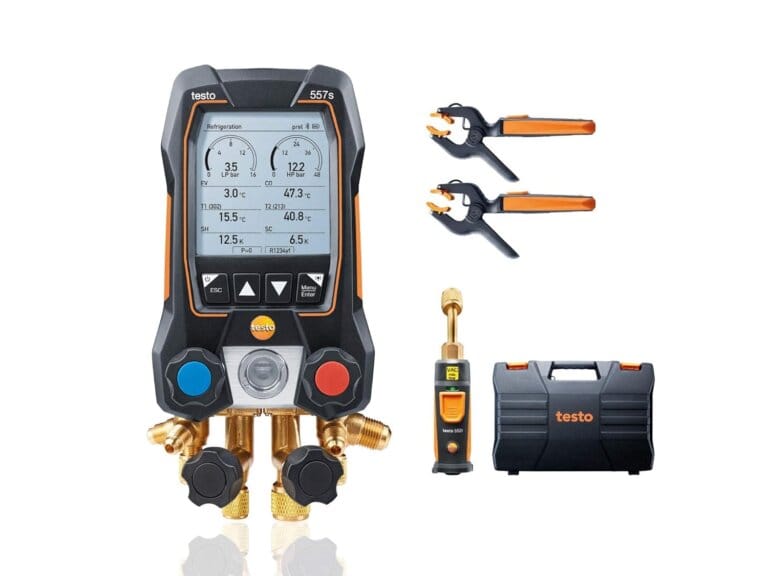
The Fieldpiece DR58 and the Testo 316-3 are heated diode detectors, and the INFICON D-TEK 3 and D-TEK Select are infrared. All four are established names worth comparing. Fieldpiece rates the DR82 infrared sensor at about 10 years, and INFICON lists its D-TEK infrared sensors at 1,000 to 5,000 hours. Check each maker’s current catalog if you want to compare more models. Pair any detector with a nitrogen regulator for pressure holding tests, and a digital manifold to log the result.
Still deciding?
Best infrared detector: Fieldpiece DR82 Infrared Refrigerant Leak Detector. Infrared sensor rated about 10 years, 0.03 oz/yr stationary sensitivity, A2L support.
Frequently asked questions
What is the best freon leak detector?
Freon is a brand name that many people use for refrigerant in general. Pick a detector that lists the refrigerants you work with, such as R-410A, R-32 or R-454B, and compare how often each sensor type needs replacing.
What is the difference between heated diode and infrared leak detectors?
Infrared sensors last far longer, with Fieldpiece rating the DR82 sensor at about 10 years and INFICON listing its D-TEK infrared sensors at 1,000 to 5,000 hours, while heated diode sensors wear out sooner and need replacing. See the picks above for models of each type.
Do I need a different leak detector for A2L refrigerants?
Check that the detector lists the A2L refrigerants you work with, such as R-32 and R-454B. Several detectors on this page list them, and the sensor type affects how often you replace parts.
Keep reading
Sources
Specifications and product details were checked against these sources: